
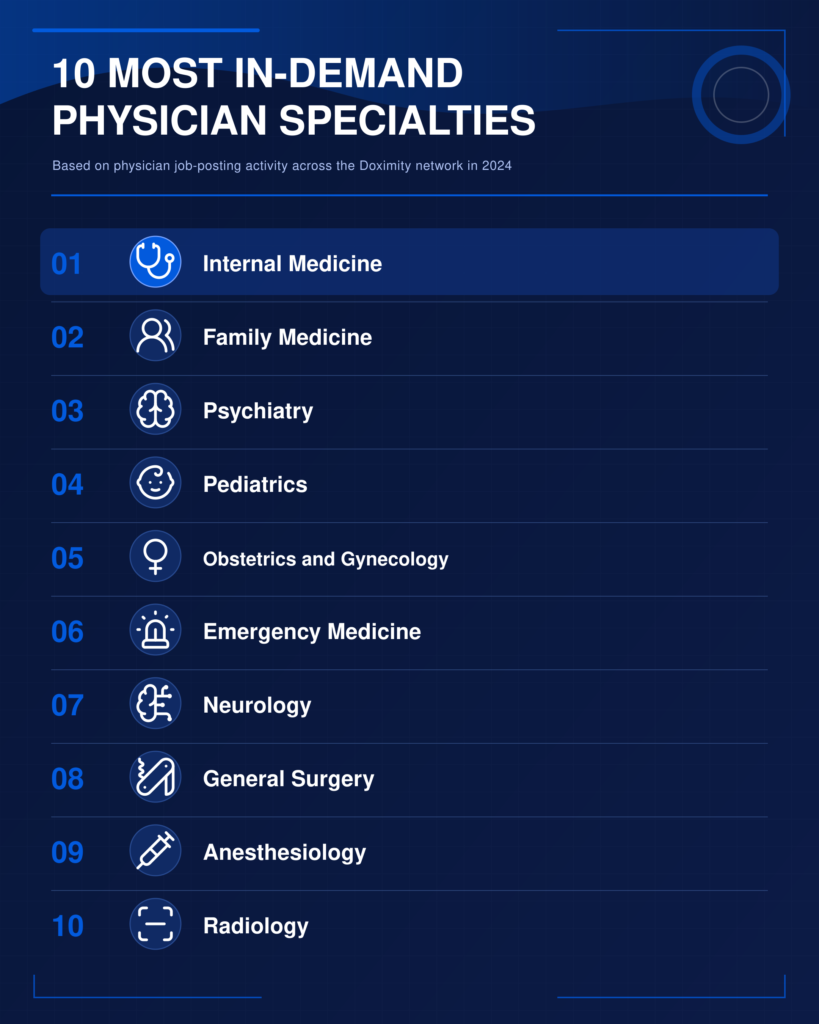
Internal medicine, family medicine, and psychiatry are currently among the most in-demand physician specialties in the United States. Pediatrics, obstetrics and gynecology, emergency medicine, neurology, general surgery, anesthesiology, and radiology also rank highly in recent physician job-posting data.
Demand is not the same everywhere. The physicians needed most can vary by location, healthcare system, patient population, government contract, and current workforce conditions.
Understanding these trends can help physicians evaluate their career options and help healthcare organizations prepare for increasingly difficult recruiting needs.
The short answer: Internal medicine, family medicine, and psychiatry currently rank among the most in-demand physician specialties. However, actual demand can vary significantly by location, employer, patient population, and healthcare setting.
Doximity’s 2025 Physician Compensation Report analyzed tens of thousands of positions posted on its network during 2024. Based on that job-posting activity, the ten specialties with the highest demand were:
What Does “In Demand” Mean for Physicians?
“In demand” can mean several different things.
A specialty may have:
- A large number of open positions
- Too few physicians entering or remaining in the field
- An aging workforce approaching retirement
- High demand in rural or underserved communities
- Long recruiting timelines
- Increased demand within a particular healthcare system
- A growing patient population with specific medical needs
- Temporary demand created by new programs or government contracts
The Doximity ranking reflects job postings on its network. It provides a useful view of physician recruiting activity, but it does not represent every available job or every healthcare employer in the country.
Physician demand should always be considered within the context of the location, employer, practice setting, and patient population.
Why Is Internal Medicine in High Demand?
Internal medicine ranked first in Doximity’s physician demand data.
Internists serve an essential role in both outpatient and inpatient care. They manage complex and chronic conditions, coordinate treatment across specialties, and care for an aging population that may have multiple health concerns.
Internal medicine physicians may work in:
- Outpatient primary care practices
- Hospitals and hospitalist programs
- Federal healthcare facilities
- Military treatment facilities
- Veterans’ healthcare settings
- Academic medical centers
- Long-term and transitional care environments
Their broad clinical experience makes them valuable across many healthcare settings. Demand can be especially strong where organizations need physicians capable of managing medically complex adult populations.
Why Does Family Medicine Continue to See Strong Demand?
Family medicine ranked second.
Family physicians provide preventive care, chronic disease management, routine treatment, and care coordination for patients across different life stages. They are often the first point of contact for patients entering the healthcare system.
Demand is affected by population growth, physician retirements, geographic shortages, and continued difficulty maintaining adequate primary care access.
Family medicine physicians can also work in a variety of environments, including outpatient clinics, urgent care centers, community health programs, military facilities, and other federal healthcare settings.
This flexibility creates opportunities, but physicians should still compare the schedule, patient volume, support, administrative workload, and scope of each position.
Why Is Psychiatry One of the Most In-Demand Specialties?
Psychiatry ranked third for overall physician demand and eighth among the most in-demand locum tenens specialties in Doximity’s report.
Several factors contribute to this need:
- Growing demand for mental health services
- Continued substance-use treatment needs
- Limited access to psychiatric care in many communities
- Geographic disparities in the availability of psychiatrists
- An aging behavioral healthcare workforce
- Demand across civilian, federal, and military healthcare systems
The Health Resources and Services Administration has also projected significant future shortages across multiple behavioral health professions. These challenges affect access to care and make qualified psychiatrists increasingly important to healthcare organizations.
Psychiatrists may find opportunities in outpatient clinics, hospitals, telehealth programs, correctional settings, veterans’ facilities, military treatment facilities, and other government-supported environments.
Why Are Pediatrics and OB/GYN Highly Recruited?
Pediatrics ranked fourth, while obstetrics and gynecology ranked fifth.
Pediatric demand can be affected by geographic shortages, reimbursement challenges, and limited availability within certain pediatric subspecialties. Some communities have difficulty maintaining adequate access even when overall population-level physician numbers appear sufficient.
OB/GYN recruiting can be affected by call coverage, geographic distribution, workforce departures, and the demanding nature of maternity and surgical care. Hospitals and healthcare systems need enough physicians to maintain safe and sustainable coverage around the clock.
For both specialties, national rankings may not reflect the severity of demand within an individual community or facility.
Why Do Hospital-Based and Procedural Specialties Remain in Demand?
Emergency medicine, general surgery, anesthesiology, and radiology all appear in the top ten.
These specialties are essential to hospital operations. Vacancies can affect emergency coverage, surgical schedules, diagnostic capacity, patient flow, and access to time-sensitive care.
Recruiting can be challenging because organizations may need physicians with:
- Specific board certification or eligibility
- Recent clinical experience
- Particular procedural competencies
- Availability for nights, weekends, or call
- Experience with a defined patient population
- The ability to complete facility credentialing and privileging
A specialty may therefore be in demand nationally while an individual position remains highly specific.
Does Higher Demand Mean Higher Compensation?
Not always.
High demand may strengthen a physician’s position when comparing opportunities, but compensation depends on more than the number of job openings. Specialty, experience, location, schedule, call, worker classification, benefits, and employer type can all affect the total package.
Some positions may use higher compensation or recruitment incentives to attract physicians. Others may compete through predictable schedules, additional time off, professional autonomy, loan-repayment opportunities, relocation support, or mission-driven work.
Physicians should evaluate the complete opportunity instead of comparing base compensation alone.
How Does Physician Demand Differ in Government Healthcare?
Government physician demand is influenced by active contracts, federal workforce needs, facility locations, mission requirements, and the availability of qualified candidates.
A military treatment facility may need a family medicine physician in one location and a psychiatrist, surgeon, or dentist in another. These needs can change as contracts begin, staffing requirements shift, or new positions receive approval.
Government physician positions may include:
- Civilian contract roles at military facilities
- Direct federal employment
- Active-duty military service
- Reserve service
- Assignments supporting veterans or other federal populations
These paths are not interchangeable. Each has its own employer, application process, responsibilities, benefits, service requirements, and credentialing standards.
Physicians should confirm exactly which type of opportunity they are considering before evaluating the terms.
Can In-Demand Physicians Receive Military Accession Bonuses?
Some active-duty Navy physician opportunities include specialty-specific incentives. Under the FY26 schedule, qualifying psychiatrists may be eligible for an accession bonus of up to $600,000 with a four-year commitment.
Active-duty Navy service is different from working in a civilian government contract position and includes becoming a commissioned military officer. Interested physicians should confirm current eligibility, commitments, and incentive details with a recruiter.
What Should Physicians Look for Besides Demand?
A high-demand specialty may create more options, but the most available job is not automatically the right job.
Before applying or accepting an offer, compare:
- Location and relocation requirements
- Patient population
- Clinical scope
- Schedule and call
- Patient volume
- Productivity expectations
- Compensation and benefits
- Credentialing requirements
- Professional liability coverage
- Administrative responsibilities
- Contract or assignment length
- Available clinical support
- Opportunities for leadership or professional growth
Demand may help you find an opening. These details determine whether the opportunity fits your career.
How Can Physicians Prepare for High-Demand Opportunities?
Physicians can position themselves to move more quickly by keeping their professional information current.
Prepare:
- An updated CV with complete employment dates
- Active and unrestricted medical licenses
- Board-certification or board-eligibility documentation
- Current clinical certifications
- Recent procedure or case logs when required
- Professional references
- Malpractice and claims information
- A clear explanation of any employment gaps
- A list of preferred locations, schedules, and practice settings
Government positions may involve additional credentialing, privileging, background screening, or access requirements. Having organized documentation can reduce preventable delays.
Frequently Asked Questions About Physician Demand
What physician specialty is most in demand?
Internal medicine ranked first in Doximity’s analysis of physician job postings from 2024. Family medicine and psychiatry ranked second and third.
What are the most in-demand primary care specialties?
Internal medicine, family medicine, and pediatrics were among the four most-recruited specialties in Doximity’s data.
Is psychiatry in high demand?
Yes. Psychiatry ranked third for overall physician demand and eighth for locum tenens demand. Behavioral health workforce shortages and growing demand for mental health services contribute to the need.
Are physician shortages the same in every state?
No. Physician availability and patient needs vary considerably by state, region, and community. Rural and underserved areas may experience more significant recruiting challenges.
Are government physician jobs in demand?
Government and military healthcare organizations recruit physicians across numerous specialties. Actual demand depends on active positions, contracts, facilities, funding, and mission requirements.
Does working at a military hospital require joining the military?
Not always. Some physicians work at military treatment facilities as civilian government contractors or federal employees. Others serve as active-duty or Reserve military officers. Candidates should confirm the employment structure for every position.
Explore Where Your Specialty Is Needed
National demand data provides a useful view of the physician workforce, but every career decision is personal.
The right opportunity should align your specialty and experience with the patient population, schedule, compensation, working environment, and mission you want to support.
The Arora Group connects physicians with government and military healthcare opportunities across the country. Our team can help qualified candidates understand current openings, position requirements, credentialing expectations, and the differences between civilian contract and military service opportunities.
Search current physician opportunities or contact The Arora Group to begin the conversation.