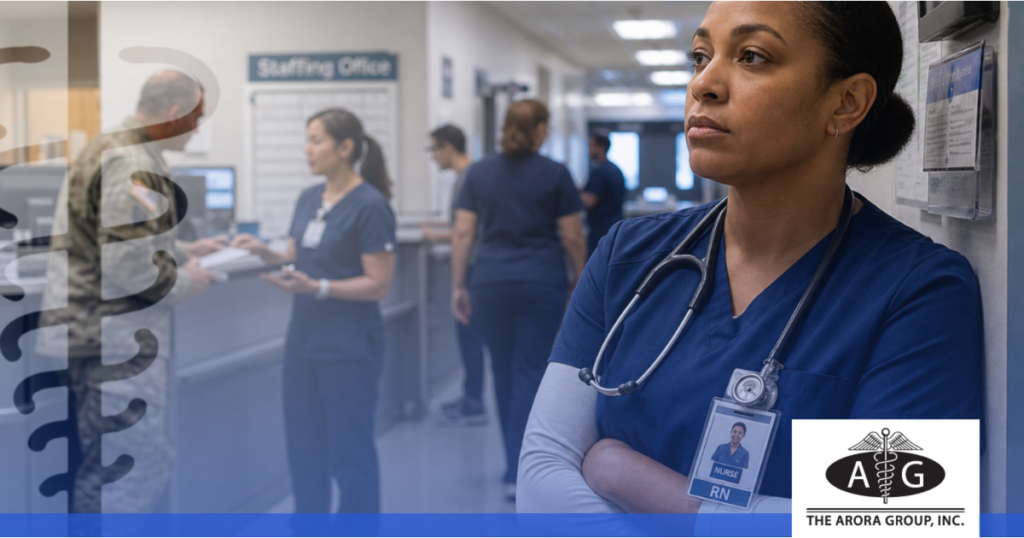
Every unfilled nursing position at a military treatment facility (MTF) lands on someone else’s desk. The charge nurse picks up an extra shift, a primary care panel grows by a few patients a week, and a service member waiting on a follow-up appointment waits a little longer. The people absorbing that gap are the ones already on the floor, and the patients affected are active duty members, retirees, and military families who depend on the facility for their care.
In our experience, facility leaders usually notice a staffing gap in the schedule before they see it in the headcount report. A shift that cannot be covered without overtime, or a clinic that starts turning away routine visits, is often the first sign that a vacancy has become a problem. This article looks at why MTFs find nursing roles hard to fill, why standard hiring approaches fall short in federal settings, and where the workforce answers are most likely to come from.
Why Military Treatment Facilities Struggle to Fill Nursing Positions
MTFs serve a patient population that is large, specific, and often on a tight schedule. Active duty service members need readiness-related care. Retirees and their families rely on the same facilities for primary care, specialty referrals, and behavioral health. When a nursing position stays open, the effect is not abstract. A pediatric clinic with one fewer nurse can slow down immunizations, and a surgical unit short of staff can reduce the number of cases it is able to schedule.
Vacant nursing positions also reduce continuity of care. Patients are most likely to get consistent, safe care when they see the same nurses and when those nurses know their histories. Each vacancy pushes more rotation and more handoffs onto the staff who remain, and that pressure tends to build. Experienced nurses who are stretched thin are more likely to leave, which creates another opening and starts the cycle again.
The shortage is not confined to one service. The Defense Health Agency, the Army, the Navy, and the Air Force each rely on credentialed nurses to deliver care across their facilities, and the same pressure points appear in each system: specialty shortfalls, rural or remote postings, and competition from civilian employers. A facility that cannot fill a nursing role is rarely the only one in its region with that problem.
Recruiting Nurses for Military Treatment Facilities Requires a Different Approach
Civilian hospital recruiting is built around speed and volume. A commercial employer can often advertise a position, interview candidates, and extend an offer within a few weeks. Federal facilities operate under procurement rules, privileging standards, and security requirements that do not compress in the same way. A nurse who is qualified on paper may still need credentialing steps completed before she can work a shift, and a recruiting approach that ignores those steps will lose good candidates to timelines they did not expect.
That difference also changes what persuades a nurse to apply. Experienced nurses rarely respond to generic promises of flexibility or sign-on bonuses alone. They want to know what the mission is, what stability looks like over the length of a contract, and what the work will actually involve. A nurse who has spent years in a busy commercial emergency department may be drawn to the chance to work in a federal environment, build skills that civilian settings rarely offer, and care for the people who serve the country. Recruiting messages that speak to those specifics tend to hold attention longer than messages that promise a great team.
This approach is not the right fit for every nurse. Someone who needs a fixed schedule, a short-term contract, or a position that can be started in a matter of days may find the federal timeline frustrating. Facility leaders should be honest with candidates about how long credentialing takes and what the contract requires, because a candidate who learns those details late is more likely to withdraw. For facilities that need to understand the hiring options more fully, our guide on how to hire temporary military healthcare staff walks through the decision points in more detail.
Military Spouses: An Overlooked Pool of Nursing Talent
Military spouses face one of the most difficult employment environments in the country. Their unemployment rate sits above 20 percent, which is five times the national average. Many of these spouses hold professional licenses, including nursing licenses, and many have spent years building clinical experience before a service member’s orders moved the family. Relocation every few years makes traditional hospital employment hard to sustain, and a nurse who loses a position at every move can lose ground in her career.
Consider a hypothetical example: a registered nurse with eight years of medical-surgical experience follows her husband to a new duty station. She has a current license, strong references, and a clear interest in staying in clinical work, but each local hospital wants a commitment she cannot make. Facilities that build roles around portability can reach nurses like her, and they gain a clinician who is motivated to stay for the length of a contract and who brings experience that transfers well across settings.
This is the logic behind the workforce solutions that The Arora Group has built around military spouse employment. Through the 4+1 Commitment, the company offers four concrete, transferable employment options for licensed clinician military spouses, which addresses the structural barriers that keep these nurses out of work. The approach is a mission-driven choice rather than a charity effort. A facility that hires a military spouse nurse is hiring a skilled clinician who understands the military lifestyle and has chosen to serve in it.
Joint Commission Certification and a Credentialed Workforce in Federal Facilities
Joint Commission certification gives facility leaders an independent, third-party measure of quality. For a federal program manager, that matters because it provides a verified benchmark that supports agency oversight without requiring the facility to conduct its own vendor quality audits. A credentialed workforce supports that standard. It means that the nurses placed in a facility have been verified against the requirements that federal clients expect, and that credential records are current when an audit or review occurs.
A staffing partner’s vetting and credentialing process is where much of that quality is built. A partner that understands federal privileging and security requirements can handle the document collection, verification steps, and follow-up that would otherwise fall to facility staff who already have full schedules. When the process runs well, the facility’s own team spends less time chasing paperwork and more time on patient care and mission work.
Certification is not a substitute for a facility’s own verification. Joint Commission status and a partner’s credentialing process reduce risk, but they do not replace the requirements a specific facility or contract places on its workforce. Facility leaders should confirm their own certification requirements, verification steps, and documentation standards before making staffing decisions, and they should ask any prospective partner to walk through how those standards are met.
Bringing Experienced Nurses Into the Mission
Facility leaders who want to close nursing gaps should start by preparing for the conversation. That means listing the specialties and shift patterns that are hardest to cover, identifying how long the facility can wait for a start date, and documenting the credentialing requirements that apply to each role. A staffing partner can respond more precisely when it knows where the gaps are and what the facility needs in the first ninety days. Our overview of federal nursing jobs in 2026 can also help leaders understand what candidates will be looking for when they compare opportunities.
Nurses considering federal service should approach the decision the same way. Think about what kind of mission you want to serve, how much schedule predictability you need, and whether the credentialing timeline fits your current situation. Federal work asks more of you up front, but it can offer stability, a mission that few civilian roles match, and the chance to care for the service members, veterans, and families who have carried the cost of national service.
The Arora Group has spent more than 35 years placing nurses, physicians, allied health professionals, and dental clinicians into roles across the Defense Health Agency, the Army, the Navy, the Air Force, and the Intelligence Community. If your facility needs a credentialed nursing workforce, or if you are a nurse ready to bring your skills to federal healthcare, contact the Arora Group’s team at aroragroup.com to start the conversation about the right role and the right timeline.