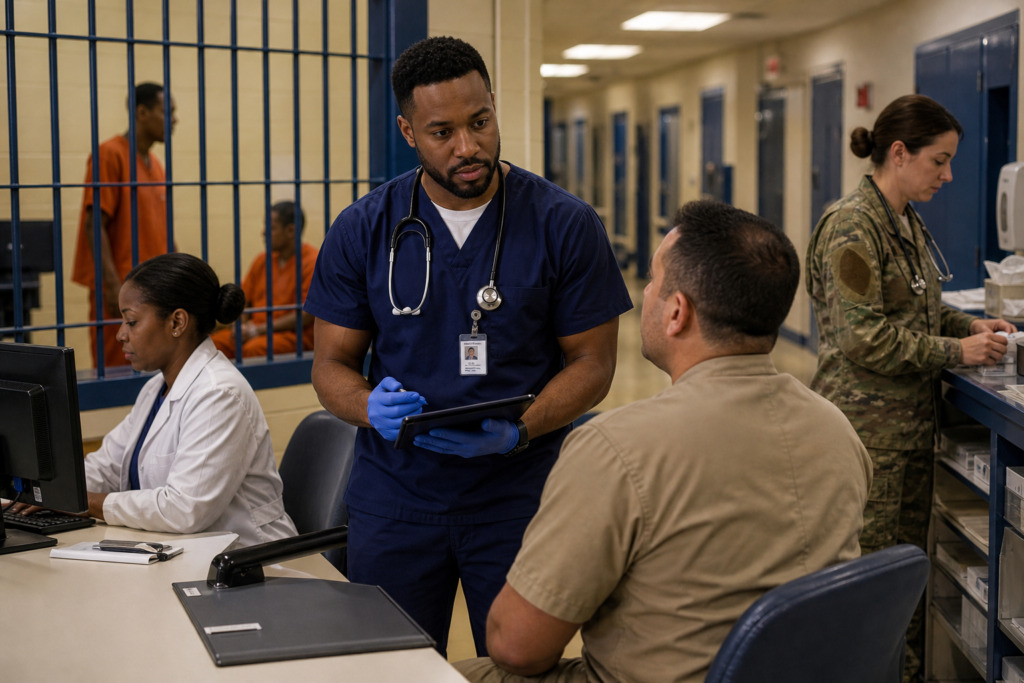
A nurse who has spent ten years in a community hospital emergency department can walk onto a federal correctional health unit and find that most of her clinical skills transfer. What doesn’t transfer is the operating environment. Security procedures, count schedules, escort requirements, and a patient population with its own specific needs all shape how care gets delivered. For contractors, that gap has direct consequences: a clinician who can’t clear facility requirements on day one is a staffing gap, not a placement.
In our experience, contractors who win and keep Bureau of Prisons work treat federal correctional care as a distinct market with its own rules, not as a variation on hospital staffing. This article explains how the Bureau of Prisons (BOP) shapes what contractors recruit and deploy, which credentialing checks deserve the most attention before a clinician starts, and how Joint Commission certification and workforce documentation factor into facility expectations.
Why Federal Correctional Care Differs From Civilian Hospital Work
Civilian hospitals exist to treat patients who come and go by their own choice. Federal correctional facilities deliver health services to people in custody, inside institutions where security is the first priority and every clinical encounter is shaped by it. A physician may need to see a patient in a housing unit rather than an exam room. A nurse may coordinate a medication pass around institutional movement restrictions. Those realities affect scheduling, documentation, and how quickly a clinician can respond to an emergency.
That difference matters for recruiting. Many clinicians drawn to federal correctional service value the stability of a government contract and the chance to build skills that a standard hospital rarely offers, such as managing chronic illness across a long-term population or practicing with a multidisciplinary team under institutional constraints. Some are also drawn by the same national service framing that shapes federal healthcare more broadly, where the work supports a public mission and not simply a patient census. Contractors who can explain that environment honestly tend to attract clinicians who stay.
For a plain-language primer on how this type of staffing is structured across federal healthcare, see our overview of government healthcare staffing in the U.S.
How Bureau of Prisons Requirements Shape Contractor Staffing
The Bureau of Prisons is the federal buyer. It defines the health services it needs, the number and type of positions it wants covered, and the performance standards a contractor must meet. Those expectations flow directly into how a contractor recruits, credentials, and deploys staff. A contractor that understands the buyer’s priorities can build a recruiting pipeline that matches them. One that doesn’t tends to spend its effort filling roles that the contract does not actually require.
Requirements vary by solicitation. Scope of work language, staffing levels, qualification standards, and reporting obligations can differ from one contract to the next, even within the same institution type. Contractors should not assume a standard template carries over from a prior award. Read each scope of work closely and note the specific duties, coverage hours, and credential requirements it names.
Map each role to the duties the contract describes. A clinician hired as a general staff position may not cover the same responsibilities as one hired for a specialty coverage line, and the difference affects both qualifications and the credentials you need to verify. This mapping step is unglamorous, but it prevents the most common mismatch we see: a candidate who is strong clinically but does not fit the coverage the solicitation actually asks for. One limitation is that tight mapping can shrink your candidate pool, so contractors should also flag which qualifications are truly required and which are preferences the buyer may accept in a substitution.
Credentialing and Licensure Checks Before a Clinician Starts
Credentialing is where placements most often stall. Before any clinician begins work, contractors should verify the general categories that federal correctional facilities expect: active professional licensure in the relevant state or jurisdiction, current certifications tied to the role, education and training records, and the background and eligibility checks the contract requires. Each category has its own documentation trail, and each one can delay a start date if it is incomplete.
A clean, organized credentialing file matters as much as the credentials themselves. During facility review, a contracting officer or facility representative may ask for proof of a license, a certification date, or a verification record, and the contractor needs to produce it quickly. A file that takes days to assemble signals a process problem, even when the clinician is fully qualified. Build a standard checklist for each role, store verification records with dates, and set reminders for renewals that fall during the contract period.
Confirm current requirements directly with the Bureau of Prisons and the contracting office rather than relying on memory or older guidance. Requirements can change between solicitations and between awards, and a credential that satisfied last year’s scope may not satisfy this year’s. A short written confirmation from the contracting office is worth more than an assumption carried forward from another contract. The trade-off is time: direct confirmation adds steps to an already crowded pre-bid schedule, but it prevents the far costlier situation of a placed clinician who cannot clear review.
Joint Commission Certification and What Facilities Expect From Contractors
Joint Commission certification is a third-party signal that a healthcare organization meets recognized quality and performance standards. For a facility weighing a staffing partner, it answers a question that would otherwise require the facility to vet the vendor’s operations independently. The certification does not replace the facility’s own oversight, but it gives program managers a verified benchmark they can point to during procurement and audit conversations.
A credentialed, well-documented workforce supports smoother facility oversight. When credential files are complete, training records are current, and staffing changes are reported promptly, the facility spends less time chasing paperwork and more time on operations. Documentation discipline also reduces the risk of a compliance gap surfacing during an audit, which is often the moment a facility starts reconsidering its vendor relationships.
The certification question tends to come up early in procurement conversations, so contractors should be ready to address it directly. Describe your certification status accurately, explain how your documentation process works, and be prepared to show examples of what a file looks like. The Arora Group holds Joint Commission certification, and we bring that standard into every federal placement we manage. Certification is not a substitute for a contractor’s own demonstrated process, however. A firm without it can still win work by showing a documented, audit-ready workflow, though that conversation usually takes longer and requires more evidence.
Preparing Your Team to Bid on Bureau of Prisons Work
Start with a short readiness review. Pull the current solicitations you are considering, compare their scope of work against your credential files, and identify staffing gaps by role. Where a role has no pool of qualified candidates, decide now whether you can recruit for it or whether the bid should be passed. A bid built on roles you cannot fill creates performance risk the buyer will eventually notice.
Build relationships with contracting officers and facility leadership before a bid deadline arrives. Questions asked early about scope, qualifications, and documentation expectations produce better proposals than questions asked in the final week. Facility leaders also tend to remember contractors who show up with clear answers rather than sales language.
For more on the federal healthcare staffing landscape, you can browse our archive of articles on staffing partners for government healthcare. If your team is working through a Bureau of Prisons solicitation and wants a second view on how its staffing requirements translate into recruiting and credentialing decisions, contact The Arora Group to start that conversation. We have operated exclusively in U.S. government and military healthcare since 1989, and we are glad to talk through what your federal correctional staffing needs look like.