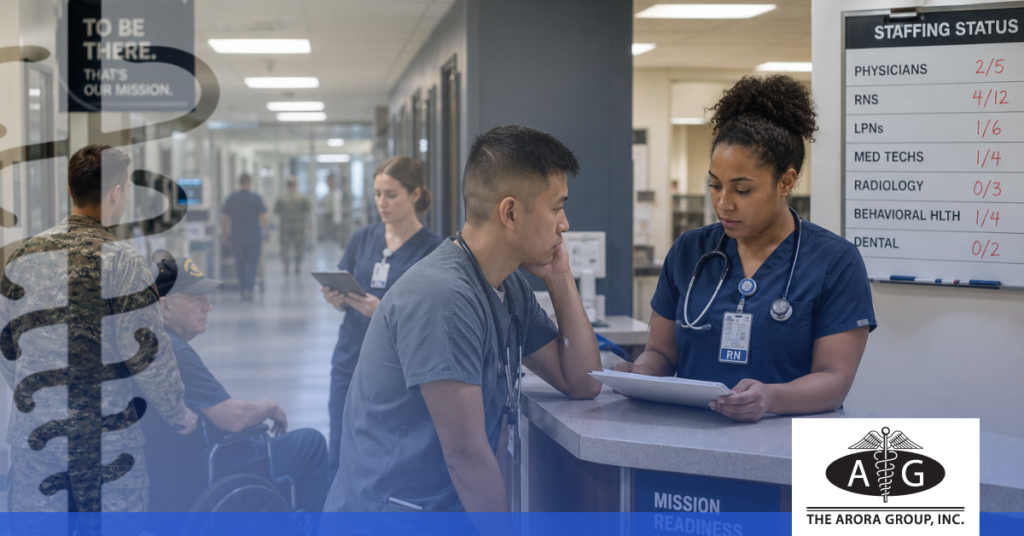
Federal healthcare systems and government contractors recruit nurses for work that supports veterans, service members, military families, incarcerated populations, public health programs, research, and other national healthcare missions. Opportunities may include bedside nursing, advanced practice, behavioral health, ambulatory care, critical care, case management, education, quality, leadership, and occupational health.
The phrase “federal nursing job,” however, can describe several different career paths. A nurse may become a federal civil-service employee, work for a private contractor at a government facility, or join a uniformed service. Each route has different pay systems, benefits, application channels, and employment terms.
That distinction should be the first step in any job search. It prevents candidates from comparing a contractor’s hourly rate with a federal employee’s salary and benefits as if the packages were identical.
The Arora Group recruits nurses for medical government contract jobs nationwide. Candidates can explore its dedicated nursing government contract opportunities and current openings.
What Counts as a Federal Nursing Career?
Federal Civil-Service Nursing
In this path, the nurse is employed directly by a federal agency. Employers may include:
- Department of Veterans Affairs
- Department of Defense civilian healthcare organizations
- Indian Health Service
- Federal Bureau of Prisons
- Department of Health and Human Services agencies
- Other federal healthcare or research programs
Most direct federal openings are posted on USAJOBS, although agencies may also maintain recruiting pages and use authorized hiring events or special authorities.
Government Contract Nursing
In a contractor role, a private employer hires the nurse to perform work supporting a federal contract. The nurse may work inside a military hospital, clinic, research environment, or other government setting but is not automatically a federal employee.
The contractor—not the federal government—generally provides the employment offer, payroll, and benefits described in the position. Applications are usually submitted through the contractor’s career site rather than USAJOBS.
The Arora Group’s guide to contractor, civilian, and service-member healthcare roles explains the differences in more detail.
Uniformed Service Nursing
Military nurses and officers in the U.S. Public Health Service Commissioned Corps follow uniformed-service accession, compensation, benefits, readiness, and service requirements. This path is not the same as civilian federal employment or contract work.
Nurses interested in the Commissioned Corps can review the official USPHS nursing career information.
Federal Nurse Salary in 2026: Why There Is No Single National Range
There is no accurate nationwide salary range that covers every federal nurse, contractor, agency, grade, specialty, and location. Pay may depend on:
- Employer and employment type
- Agency pay authority
- Occupation and position
- Grade, level, or step
- Education and experience
- Specialty and certifications
- Work location
- Local labor market
- Shift, overtime, on-call, or premium-pay rules
- Recruitment or retention incentives
- Contract terms
Use the salary range shown in the active announcement as the primary source. Confirm whether the amount is hourly or annual and whether it includes locality, market, shift, or other adjustments.
How Federal Nursing Pay Systems Work
VA Title 38 Nurse Pay
Many VA registered nurses and advanced practice nurses are appointed under Title 38 authorities and do not simply follow a standard GS-11-to-GS-15 progression. VA maintains location-specific nurse schedules that reflect occupation, grade or level, and applicable pay-setting rules.
The official VA Title 38 pay schedules should be used alongside the active job announcement. Because schedules vary by facility and coverage area, copying a range from one city can give candidates a misleading expectation for another.
General Schedule and Related Federal Pay
Some federal nursing or nursing-adjacent positions use the General Schedule, special salary rates, or other statutory pay systems. GS compensation combines grade and step with the locality rules applicable to the position.
OPM publishes official annual federal salary tables. Confirm the pay plan and occupational series listed in the vacancy rather than assuming every nurse uses the same table.
Government Contractor Pay
Nurses employed by a government contractor are paid under the employer’s compensation structure and the applicable position terms. A federal GS or VA pay table does not automatically control contractor compensation.
For contractor roles, review:
- Hourly or salaried status
- Guaranteed or expected hours
- Overtime treatment
- Shift and weekend differentials
- On-call compensation
- Paid leave and holidays
- Health and retirement benefits
- Travel or relocation terms
- Professional liability coverage
- Contract duration and extension conditions
Browse current nurse jobs with The Arora Group for active position-specific details.
Benefits: Federal Employee vs. Contractor
Benefit language must match the employment relationship. A nurse working at a federal facility does not automatically receive federal employee benefits.
Benefits for Eligible Federal Civilian Employees
Depending on appointment type and eligibility, direct federal employment may include:
- Federal Employees Health Benefits coverage
- Federal Employees’ Group Life Insurance
- Federal Employees Retirement System coverage
- Thrift Savings Plan participation
- Paid annual and sick leave
- Paid federal holidays
- Paid parental leave for eligible employees
- Flexible spending or dental and vision options
- Education, loan-repayment, or recruitment incentives for eligible positions
OPM explains that FERS includes a basic benefit, Social Security, and the Thrift Savings Plan. Review the official FERS information and FEHB program guidance for federal benefit details.
CSRS may still apply to certain long-tenured employees with prior covered service, but it should not be presented as a normal retirement plan for a new federal hire in 2026.
VA Education and Loan-Repayment Programs
Some VA nursing positions may be eligible for recruitment, retention, education, or loan-repayment programs. Eligibility is not automatic and should be confirmed in the vacancy and written offer.
For example, VA describes the Education Debt Reduction Program for eligible hard-to-recruit and retain healthcare positions. Program limits, service obligations, qualifying debt, and position eligibility apply.
Do not advertise a loan-repayment amount as a standard benefit for every federal or contractor nurse.
Benefits for Government Contract Nurses
Contractor benefits are established by the employing company and role. Packages may include health coverage, paid leave, retirement options, disability or life coverage, and other benefits, but the exact terms vary.
Ask for:
- Benefits summary and eligibility date
- Employee premium contribution
- Paid-time-off rules
- Holiday and sick-leave treatment
- Retirement plan and employer contribution
- Disability and life coverage
- Continuing education or certification support
- Professional liability terms
Only the current job posting, offer, and plan documents can confirm the package.
Common Federal and Government Contract Nursing Roles
Available roles change with agency and contract needs. Examples include:
- Registered nurse
- Licensed practical or vocational nurse
- Family, adult-gerontology, psychiatric, or other nurse practitioner
- Certified registered nurse anesthetist
- Clinical nurse specialist
- Nurse manager or supervisor
- Critical care, emergency, perioperative, or medical-surgical nurse
- Behavioral health nurse
- Occupational health nurse
- Public health nurse
- Case manager or care coordinator
- Research nurse
- Quality, patient safety, or utilization-management nurse
- Nurse educator
Search by specialty and location rather than relying only on the keyword “nurse.” Government announcements may use occupational series, specialty titles, or agency-specific naming conventions.
Basic Qualifications and Licensure
Requirements vary by employer and position. A posting may require:
- Graduation from an approved or accredited nursing program
- Active, current, full, and unrestricted licensure
- Specialty certification
- Prescriptive authority for applicable APRN positions
- Recent clinical experience in the required setting
- BLS, ACLS, PALS, NRP, or other role-specific certification
- Credentialing and privileging
- Occupational health clearance
- Background, suitability, fitness, or facility-access review
- Citizenship or work-authorization status specified by the role
Do not assume every federal job requires a license issued by the state where the facility is located. Certain federal systems operate under nationwide practice authorities or qualification rules. Other positions—including contractor, telehealth, or nonfederal practice—may have different requirements.
VA publishes occupation-specific standards in its qualification standards repository. The active announcement remains the controlling source for the opening.
How to Apply for Direct Federal Nursing Jobs
1. Build a USAJOBS Profile
Create a profile, save searches, and set alerts for your specialty and target locations. Use the USAJOBS nurse search as a starting point.
2. Read the Entire Announcement
Pay attention to:
- Who may apply
- Appointment type
- Pay plan and range
- Required experience and education
- Licensure and certification rules
- Specialized experience
- Required documents
- Assessment questions
- Application deadline and time zone
- Conditions of employment
3. Prepare the Required Federal Résumé
USAJOBS currently instructs applicants to submit a résumé of two pages or fewer and to show how they meet the announcement’s qualifications. Follow the current USAJOBS résumé requirements rather than older advice recommending an unrestricted résumé length.
Include the information the announcement requests, such as:
- Employer and role
- Month and year of employment
- Hours worked per week when requested
- Detailed duties and accomplishments relevant to qualifications
- Education, licenses, and certifications
- Supervisor or reference information if required
Use plain language and explain acronyms.
4. Submit Every Required Document
Depending on the announcement, documents may include:
- Résumé
- Transcripts
- License or certification records
- Professional documents
- Veterans’ preference documentation
- Federal employment forms
- Responses to occupational questionnaires
Do not attach a background check, supervisor letter, or credentialing document unless the announcement or authorized hiring contact requests it.
5. Track the Application and Respond Promptly
Monitor USAJOBS and email for assessments, interviews, document requests, tentative-offer steps, credentialing, and background instructions. A referral is not an offer, and a tentative offer is not a confirmed start date.
How to Apply for Government Contract Nursing Jobs
Contract roles follow the employer’s application process rather than the USAJOBS process.
1. Search the Contractor’s Career Site
Review The Arora Group’s nursing job listings and advanced practice openings by location and specialty.
2. Tailor a Clinical Résumé
Highlight:
- Recent experience in the required setting
- Patient population and acuity
- Clinical procedures and competencies
- Leadership and interdisciplinary work
- Quality and safety initiatives
- Required EHR experience
- Active licenses and certifications
Use measurable outcomes only when they are documented and accurately represent your contribution.
3. Confirm Contract-Specific Requirements
Ask the recruiter about:
- Employer and employment classification
- Schedule and expected hours
- Compensation and benefits
- Contract and assignment duration
- Credentialing and privileging
- Background or access requirements
- Required start-date approvals
- Professional liability coverage
4. Complete Credentialing and Screening
Submit sensitive information only through approved secure channels. Keep credentials current and provide complete, accurate history when authorized forms request it.
The Arora Group explains its process on the healthcare hiring process page.
What to Highlight in a Nursing Application
Strong application evidence is specific, relevant, and verifiable.
Clinical Scope
Describe the units, patient populations, acuity, procedures, ratios, and responsibilities that relate to the job.
Quality and Patient Safety
Explain your role in an initiative, the method used, and the verified result. Avoid claiming a team outcome as an individual achievement.
Leadership
Include charge responsibilities, precepting, training, committee work, emergency response, or process improvement when relevant.
Mission-Relevant Experience
Experience with military-connected populations, veterans, underserved communities, correctional health, public health, or high-acuity environments may be relevant when the announcement identifies it.
Technology and Documentation
List the EHR and clinical systems you have actually used. Do not claim proficiency based on limited exposure.
Executive Core Qualifications are generally associated with Senior Executive Service selection. Most nursing applicants should address the competencies and qualifications in the specific announcement—not prepare ECQ narratives unless expressly required.
Illustrative Scenario: Comparing Two Nursing Paths
Consider a hypothetical family nurse practitioner evaluating two opportunities: a direct VA appointment and a contractor role at a military clinic.
For the VA position, the candidate reviews the USAJOBS announcement, local Title 38 salary information, federal benefits eligibility, credentialing requirements, and any position-specific education incentive. The candidate submits the résumé and documents through the official federal channel.
For the contractor role, the candidate reviews the employer’s stated salary or hourly rate, schedule, benefits, professional liability coverage, assignment terms, and facility onboarding requirements. The application goes through the contractor’s career site.
The candidate compares total compensation, schedule, mission, mobility, retirement, leave, and contract risk—not salary alone.
This example is illustrative. It does not represent a real applicant, guarantee an offer, or imply that either employment path is universally better.
A 30-Day Federal Nursing Job-Search Plan
Week 1: Choose the Path
- Decide whether you want direct federal, contractor, or uniformed-service roles.
- Select specialties and locations.
- Identify compensation and scheduling priorities.
Week 2: Prepare Materials
- Update your résumé.
- Verify licenses and certifications.
- Obtain transcripts through the appropriate source if needed.
- Create a secure credential inventory without storing sensitive identity data unnecessarily.
Week 3: Search and Tailor
- Set USAJOBS alerts.
- Review The Arora Group’s current nursing openings.
- Tailor each application to the stated qualifications.
- Create a comparison sheet for pay, benefits, schedule, and employment type.
Week 4: Apply and Prepare
- Submit complete applications before the deadline.
- Prepare job-related interview examples.
- Confirm references are willing and reachable.
- Track every application and required follow-up.
Take the Next Step in Your Government Nursing Career
Federal and government contract nursing can provide mission-driven work across a wide range of clinical settings. The best opportunity depends on the employment relationship, specialty, location, schedule, compensation, benefits, and long-term career goals.
Start by identifying the path. Then compare current openings using authoritative salary and benefit information rather than a generic national range.
Ready to explore nursing government contract jobs? Search nurse openings with The Arora Group or contact a healthcare recruiter for position-specific information.