Career Growth

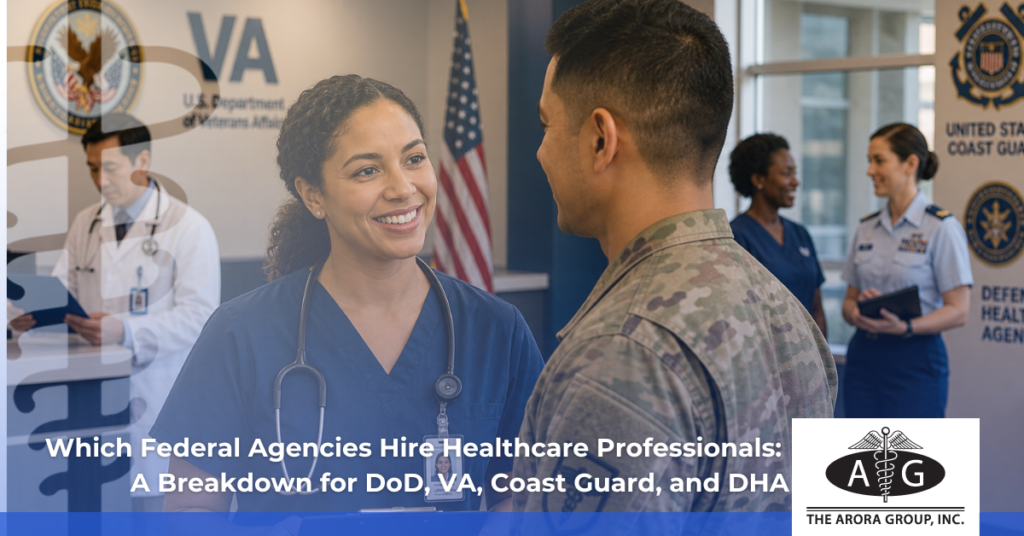
Which Federal Agencies Hire Healthcare Professionals: A Breakdown for DoD, VA, Coast Guard, and DHA

Posted on

If you’re a healthcare professional exploring federal employment, understanding where your skills fit is crucial. This guide explains the major federal agencies that hire clinicians and allied health staff, what roles are common, and practical steps to pursue these career paths. It’s written for clinicians, nurses, therapists, and public health specialists considering federal service, with… Read More »


Read More
Career Advice

Federal Nursing Jobs for New Graduates: Pathways, Timelines, and Entry-Level Roles

Posted on

Federal healthcare can give new nurses an opportunity to begin their careers in mission-driven settings that serve veterans, military families, American Indian and Alaska Native communities, and other patient populations connected to government programs. The path is not always straightforward. “Federal nursing” may refer to direct civil-service employment, a structured residency or student program, uniformed… Read More »

Read More
Career Advice

Federal Nursing Jobs in 2026: Salary, Benefits, and How to Get Hired

Posted on

Federal healthcare systems and government contractors recruit nurses for work that supports veterans, service members, military families, incarcerated populations, public health programs, research, and other national healthcare missions. Opportunities may include bedside nursing, advanced practice, behavioral health, ambulatory care, critical care, case management, education, quality, leadership, and occupational health. The phrase “federal nursing job,” however,… Read More »

Read More
Career Advice

Security Clearance and MTF Privileging: What Clinicians Need to Know Before Applying

Posted on

Clinicians applying to work in a military treatment facility, or MTF, may encounter several reviews that do not usually appear together in a private-sector hiring process. Professional credentials must be verified. Some practitioners need clinical privileges. The position may require a background investigation, fitness or suitability determination, facility-access credential, or—less commonly for routine clinical work—a… Read More »

Read More
Career Growth

What Federal Healthcare Contract Jobs Actually Look Like: A Clinician’s Plain-Language Guide

Posted on

Federal healthcare contracts give clinicians an opportunity to support service members, military families, veterans, and other patient populations served by government programs. Depending on the position, clinicians may work in military treatment facilities, government clinics, federal medical centers, research environments, or other contracted settings. These roles can offer mission-driven work, defined schedules, and experience within… Read More »

Read More
Career Advice

Work-Life Balance in Government Healthcare: Why Many Clinicians Prefer Contract Roles

Posted on

For many clinicians, work-life balance in government healthcare looks very different from what they experience in traditional hospital roles. Over time, that strain can lead to burnout, missed family time, and a feeling that work is always in the way. Government healthcare contract roles can offer a different path, one that balances meaningful clinical work with… Read More »

Read More
Career Advice

Inflation-Proofing Your Healthcare Career: Skills That Stay in Demand

Posted on

  Rising costs affect everyone. Whether it’s groceries or rent, inflation makes it harder to stretch your paycheck. For healthcare professionals, the impact can feel even more personal. You care for others every day. But how do you make sure your career stays resilient through economic uncertainty? The good news is that some healthcare roles… Read More »

Read More
Career Advice

Why Flexibility Is the Best Career Insurance in Today’s Healthcare Job Market

Posted on

Staffing shortages and shifting regulations continue to disrupt the healthcare job market. Technology adds another layer of pressure as systems evolve and new tools change daily workflows. For healthcare professionals, flexibility offers more than convenience. It serves as a strategy for staying relevant. Those who adjust quickly to unfamiliar routines or take on new patient… Read More »

Read More