
When physicians think about changing jobs, work-life balance is often near the top of the list. A higher salary may be attractive, but it can lose some of its value when it comes with unpredictable hours, frequent call, excessive administrative work, or little time away from the job.
This leads to a common question: Which physician jobs offer the best work-life balance?
It is tempting to rank specialties from best to worst. Specialty certainly matters, but it is only part of the answer. The employer, practice setting, schedule, patient volume, call requirements, and performance expectations can have just as much influence on a physician’s quality of life.
Which Specialties Rank Best for Work-Life Balance?
Some medical specialties are more commonly associated with predictable schedules, fewer emergencies, and greater control over working hours. In this video, we look at several specialties that may offer physicians a more sustainable balance between their careers and their lives outside of work.
However, specialty is only part of the equation. The employer, practice setting, patient volume, call requirements, and administrative workload can significantly change the experience of any physician job.
Watch the video, then continue reading to learn what physicians should evaluate beyond specialty rankings.
What Does Work-Life Balance Mean for a Physician?
Work-life balance does not necessarily mean working fewer hours or choosing an easier position. For many physicians, it means having enough predictability and control to build a sustainable career.
A physician job with strong work-life balance may include:
- Clearly defined working hours
- Predictable shifts
- Limited nights, weekends, or holidays
- Manageable call responsibilities
- Reasonable patient volumes
- Adequate clinical and administrative support
- Protected time away from work
- Clear expectations around documentation and productivity
- Work that continues to feel meaningful
The right balance looks different for every physician. One person may prefer a busy, shift-based environment that allows them to completely disconnect afterward. Another may value regular daytime hours, limited call, and a consistent patient population.
Which Physician Jobs Have the Best Work-Life Balance?
There is no single physician specialty or job that guarantees work-life balance. In general, positions with defined schedules, limited call, manageable patient loads, and strong coverage tend to provide greater predictability.
Some outpatient and clinic-based positions may offer regular daytime hours. Shift-based positions can create a clearer separation between work and personal time, although nights and weekends may still be required. Other roles may provide flexibility through telehealth, administrative responsibilities, teaching, research, or a combination of clinical and nonclinical work.
Specialties that involve emergency coverage, deliveries, surgery, or complex inpatient care may have less predictable schedules. However, a physician’s experience can still vary significantly based on the facility and the way the position is structured.
The most important point is that a specialty ranking should be the beginning of the conversation—not the final answer.
Does Specialty Determine Physician Work-Life Balance?
Specialty influences work-life balance, but two physicians in the same specialty can have very different experiences.
For example, one family medicine physician may work in a high-volume private practice with productivity requirements and significant work after clinic hours. Another may work in a structured government clinic with defined hours, established patient volumes, and limited call.
Similarly, a specialist working in a hospital may have different scheduling and coverage requirements than someone practicing the same specialty in an outpatient, academic, government, or contract setting.
When comparing physician opportunities, look beyond the job title. The conditions surrounding the position often matter as much as the specialty itself.
What Factors Should Physicians Compare?
Before deciding whether a position will support a sustainable lifestyle, ask detailed questions about the following areas.
Schedule and Call
Confirm the normal working hours, shift length, weekend expectations, holiday coverage, and call frequency. Ask how often the schedule changes and how far in advance it is published.
Patient Volume and Clinical Pace
Understand how many patients you will typically see and whether volume changes during certain periods. Ask how the organization responds when staffing levels are low or patient demand increases.
Productivity Expectations
Find out whether compensation or performance is tied to relative value units, patient volume, collections, or other productivity measures. A high compensation figure may come with expectations that significantly affect the pace of the job.
Administrative Responsibilities
Ask how much time physicians spend on documentation, inbox management, prior authorizations, meetings, and other nonclinical work. Determine whether administrative time is built into the schedule.
Coverage and Time Off
Learn how patient responsibilities are handled when physicians take leave. A strong time-off policy is less valuable if physicians feel unable to use it because adequate coverage is not available.
Support and Resources
Ask about nursing support, advanced practice providers, administrative staff, clinical leadership, and available resources. The right support structure can make a demanding position more sustainable.
Mission and Career Fit
Work-life balance is also connected to purpose. Physicians may be more satisfied when the patient population, organization, and mission align with what motivates them professionally.
Can Government Physician Jobs Offer Better Work-Life Balance?
Some government physician jobs and medical government contract positions offer defined schedules, clear scopes of practice, and structured working environments. Depending on the opportunity, a role may include consistent daytime hours, limited call, or fewer productivity pressures than certain private-sector positions.
These features are not universal. Government healthcare schedules vary according to the facility, patient population, specialty, contract, and mission requirements. Some positions still require nights, weekends, holidays, or on-call coverage.
Physicians should review each opportunity individually and confirm the working conditions in writing. The Arora Group’s guide to what federal healthcare contract jobs actually look like explains several of the items candidates should evaluate before accepting a position.
Physicians comparing career settings can also review government healthcare versus hospital jobs for additional information about schedules, workload, administrative requirements, and mission.
Questions to Ask Before Accepting a Physician Job
Use the interview and offer process to ask specific questions:
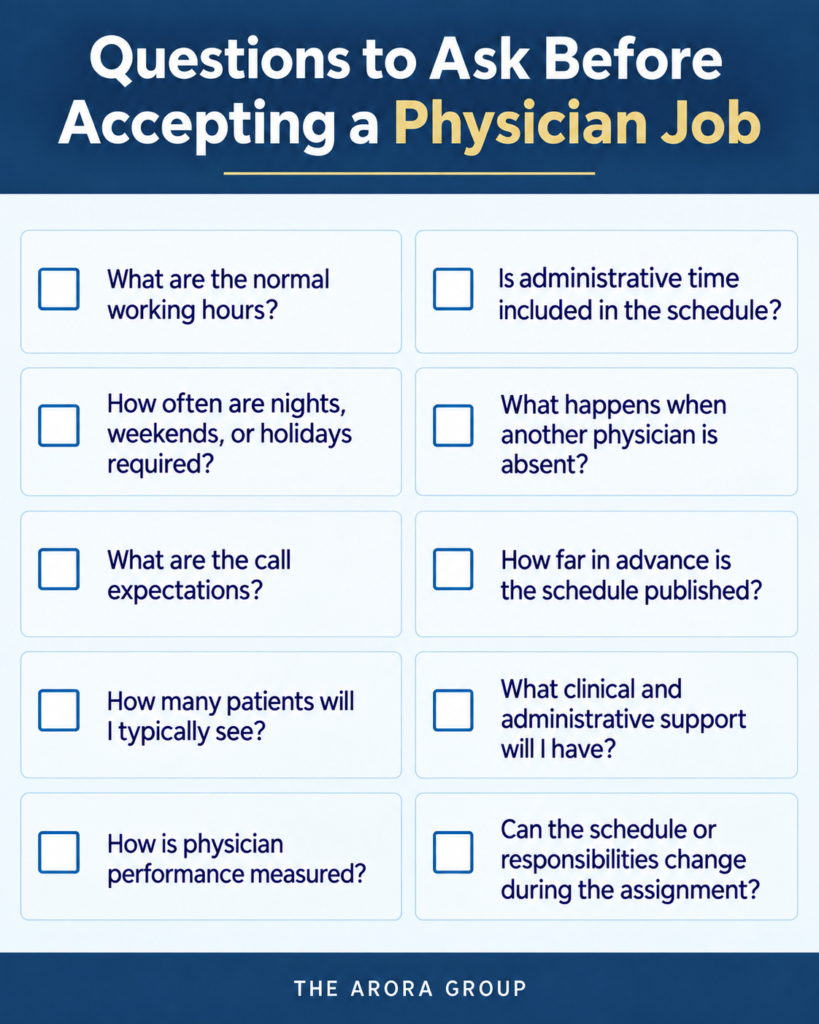
The answers will provide more useful information than a specialty ranking alone.
Frequently Asked Questions About Physician Work-Life Balance
What physician job has the best work-life balance?
No single physician job offers the best work-life balance for everyone. Positions with predictable hours, limited call, manageable patient volumes, adequate support, and clear performance expectations are generally more likely to support a sustainable lifestyle.
Does a physician’s specialty determine work-life balance?
Specialty plays a role, but the practice setting and employer can be equally important. Physicians in the same specialty may experience very different schedules, workloads, and administrative demands.
Are government physician jobs good for work-life balance?
Some government physician positions offer structured schedules and clearly defined responsibilities. Requirements vary, so candidates should confirm the schedule, call, workload, and coverage expectations for each individual opportunity.
How can physicians avoid burnout when changing jobs?
Physicians can reduce the risk of entering another unsustainable position by carefully reviewing the schedule, patient volume, productivity requirements, administrative workload, support resources, and time-off coverage before accepting an offer.
Find a Physician Career That Fits Your Priorities
The best physician job is not determined by salary, specialty, or schedule alone. It is the opportunity that provides the right combination of professional purpose, compensation, working conditions, and time outside of work.
The Arora Group connects physicians with government healthcare opportunities across the country. Our team can help you understand the schedule, qualifications, working environment, and mission associated with each available position.
Ready to explore your options? Search current healthcare opportunities or contact The Arora Group to start a conversation.