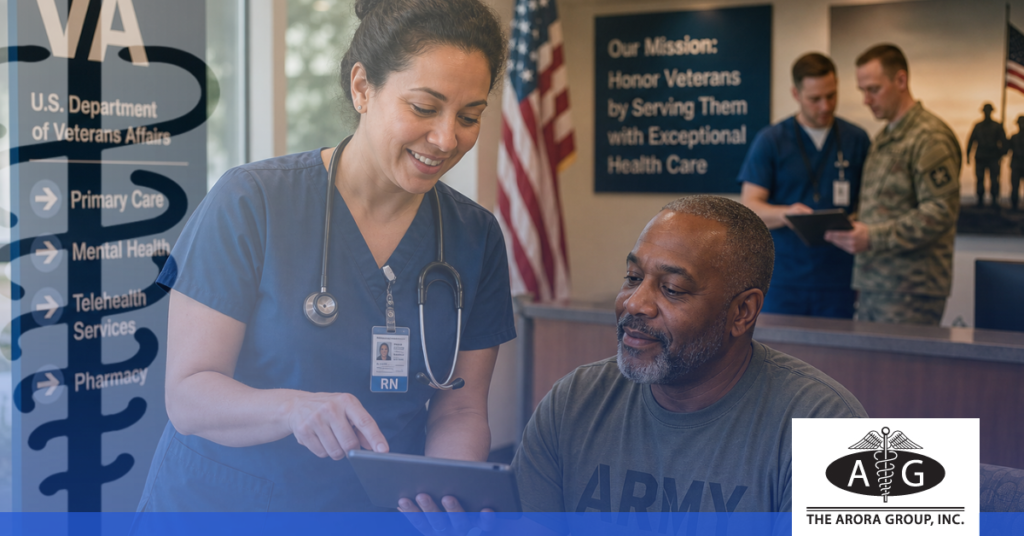
Federal healthcare contracts give clinicians an opportunity to support service members, military families, veterans, and other patient populations served by government programs. Depending on the position, clinicians may work in military treatment facilities, government clinics, federal medical centers, research environments, or other contracted settings.
These roles can offer mission-driven work, defined schedules, and experience within large healthcare systems. They also involve requirements that may differ from private-sector employment, including contract-specific qualifications, credential verification, clinical privileging, background or suitability screening, and facility onboarding.
No two opportunities are identical. Schedule, compensation, benefits, contract length, licensure requirements, and clearance obligations depend on the position, facility, employer, and underlying government contract. This guide explains what to review so you can evaluate each role on its actual terms.
The Arora Group connects healthcare professionals with medical government contract jobs nationwide and supports candidates through recruiting, credentialing, screening, and onboarding.
What Is a Federal Healthcare Contract Job?
In a federal healthcare contract role, a private contractor employs or engages healthcare professionals to deliver services under an agreement with a government agency. The clinician supports a federal mission but generally is not a federal civil-service employee solely because the work occurs at a government facility.
This distinction matters. A contractor position, a federal civilian appointment, and military service can involve different employers, benefits, application processes, responsibilities, and legal terms. The Arora Group’s guide to contractor, civilian, and service-member healthcare roles provides a useful comparison.
Clinicians interested in direct federal employment can also review USAJOBS, the federal government’s official employment site. Contractor opportunities are typically posted by the company holding or supporting the applicable contract.
Where Federal Contract Clinicians May Work
Work settings vary by agency and contract. Examples may include:
- Military hospitals and outpatient clinics
- Department of Veterans Affairs facilities
- Community-based clinics supporting federal programs
- Occupational health or readiness clinics
- Dental clinics
- Behavioral health settings
- Research or administrative healthcare programs
- Telehealth operations where authorized by the contract and facility
Before applying, confirm the exact agency, worksite, patient population, clinical department, and employer. Do not assume that every government healthcare role is a VA position or that the rules are interchangeable across agencies.
The Arora Group has provided healthcare workforce solutions to the Defense Health Agency, Army, Navy, Air Force, Intelligence Community, and other federal agencies. Learn more about its government healthcare solutions.
What a Typical Federal Healthcare Contract May Include
Defined Clinical Scope
The position description or work statement should identify the services to be performed. Depending on the role, responsibilities may include:
- Primary or specialty care
- Inpatient coverage
- Urgent or ambulatory care
- Behavioral health services
- Dental care
- Diagnostic imaging or laboratory services
- Rehabilitation or allied health services
- Care coordination
- Clinical administration
Ask whether the contract defines productivity, documentation, access, readiness, quality, or patient-flow expectations. Confirm which duties require clinical privileges and whether the facility may change the scope after onboarding.
Work Schedule and Coverage Requirements
Government healthcare schedules may be structured, but predictable hours are not universal. Some positions involve fixed weekday shifts; others may require nights, weekends, holidays, on-call coverage, or rotating schedules.
Verify in writing:
- Weekly hours
- Shift start and end times
- Call obligations
- Weekend and holiday requirements
- Overtime rules
- Schedule-change procedures
- Coverage expectations during federal closures or emergencies
- Telework or telehealth eligibility
Contract and Assignment Length
Some assignments are designed for a defined period, while others continue through contract options or renewals. A government customer’s contract period does not necessarily guarantee an individual clinician employment for the full term.
Ask about:
- Anticipated assignment duration
- Start-date contingencies
- Extension process
- Notice provisions
- Funding or option-year dependencies
- Procedures if the contract, worksite, or staffing requirement changes
Compensation and Benefits
Compensation structures differ by role and worker classification. A package may include wages or salary, health coverage, paid time off, retirement benefits, or other employer-sponsored benefits. Certain opportunities may offer relocation, travel, housing, or completion-related support, but candidates should not assume these are standard.
Review the written offer and applicable plan documents. Clarify:
- Employee or independent-contractor status
- Base compensation and pay frequency
- Overtime or premium-pay treatment
- Paid leave and holiday policies
- Health and retirement eligibility
- Travel and relocation reimbursement
- Continuing education or licensure support
- Professional liability coverage
- Post-assignment obligations
If a position is offered on a 1099 basis, consult qualified tax and legal professionals about the implications rather than relying only on a pay-rate comparison.
Credentialing, Privileging, and Screening Are Different Processes
Candidates often use these terms interchangeably, but they serve different purposes.
Credentialing
Credentialing verifies professional qualifications such as education, training, licenses, certifications, employment history, references, and professional conduct information.
Privileging
Privileging authorizes a clinician to perform specific clinical services within the facility or health system. The approved privileges may be narrower than the clinician’s full license or past scope of practice.
Background or Suitability Screening
Government contract positions may require identity verification, fingerprinting, background investigation, drug screening, health documentation, or other checks specified for the role and facility.
Security Clearance
Some roles require a formal security clearance or access determination; many do not. Never describe every government healthcare screening process as a “security clearance.” Ask the recruiter which investigation, suitability determination, access credential, or clearance applies to the specific position.
The Arora Group explains its process on the healthcare hiring process page and provides additional guidance on credentials and clearances.
Documents to Prepare Before Applying
A complete, organized file can reduce avoidable delays. Requirements vary, but clinicians may be asked for:
- Current CV or résumé with month-and-year work dates
- Active professional licenses
- Board certification or eligibility documentation, where required
- Education and postgraduate training records
- National provider or professional identifiers, where applicable
- Current life-support certifications required for the role
- Immunization, occupational health, or fit-testing records
- Continuing education records
- Professional references
- Malpractice or claims history
- Explanations for employment gaps or disclosed professional matters
- Identity and work-authorization documents
Do not send sensitive documents through an unverified channel. Follow the recruiter’s secure submission instructions and respond promptly when clarification or updated documentation is requested.
For a more detailed overview, read What Credentials Are Needed for Government Healthcare Jobs?.
Licensure and Clinical Qualification Requirements
The required license depends on the profession, contract, agency, and worksite. Some federal positions may accept an active, unrestricted license from any U.S. jurisdiction, while other opportunities may impose additional or different requirements. State law may still matter in certain circumstances, including telehealth, off-site practice, or work outside the applicable federal setting.
Candidates should verify:
- Acceptable licensing jurisdictions
- Requirement for an unrestricted license
- Board-certification or eligibility rules
- Required recent clinical experience
- Procedure-specific competency requirements
- Controlled-substance registration requirements, if applicable
- Life-support and specialty certifications
- Whether privileges are transferable between facilities
The Department of Veterans Affairs publishes credentialing standards for covered VHA healthcare providers in VHA Directive 1100.20. DoD facilities use their own credentialing and privileging frameworks, supported in part by systems such as the Centralized Credentials Quality Assurance System.
These official materials provide context, but the job posting, contract requirements, recruiter, and credentialing team should be the sources for position-specific instructions.
EHR Systems and Documentation Expectations
Federal health environments use agency- and facility-specific health information systems. Platforms can change as organizations modernize or transition systems. Do not assume that a VA role will use one particular interface or that every military facility has the same workflow.
Ask:
- Which EHR and supporting applications are currently used?
- Is training provided before independent clinical work?
- Are there documentation-completion targets?
- What templates or clinical decision-support tools are required?
- Who handles access problems?
- Will the facility evaluate EHR proficiency during onboarding?
If you have experience with CPRS, VistA, Oracle Health, MHS GENESIS, or another federal platform, list it accurately on your résumé. Do not imply proficiency with a system you have only observed.
Common Federal Healthcare Contract Roles
The available mix changes with active contracts and facility demand. Roles may include:
- Physicians and medical specialists
- Nurse practitioners and physician assistants
- Registered nurses and licensed practical or vocational nurses
- Dentists, hygienists, and dental assistants
- Behavioral health professionals
- Pharmacists and pharmacy technicians
- Radiology and diagnostic imaging professionals
- Laboratory professionals
- Rehabilitation clinicians
- Medical assistants and technicians
- Clinical coordinators and administrative support professionals
Browse current healthcare contract openings rather than relying on a general list. Each posting should be evaluated separately for employment status, location, schedule, compensation, qualifications, and screening requirements.
How Federal Contract Work May Differ From Private-Sector Practice
Mission and Patient Population
Clinicians may care for active-duty service members, military families, retirees, veterans, or other defined populations. Understanding the mission and patient community is essential.
Standardized Procedures
Government facilities often operate under detailed policies, contract requirements, quality controls, and documentation standards. Clinicians must follow the requirements applicable to the facility and their approved scope.
Multiple Organizations in the Hiring Process
The employer, government customer, credentialing office, security or suitability office, and facility leadership may each complete part of the review. This can make the timeline longer and less predictable than a standard private-practice hire.
Contract-Specific Performance Expectations
Measures may address access, documentation, quality, readiness, schedule adherence, or other deliverables. Ask which measures apply to the individual role, how they are calculated, and who provides feedback.
Questions to Ask Before Accepting an Offer
Use the interview and offer process to obtain clear, position-specific information.
Role and Schedule
- What is the clinical scope and expected patient volume?
- What are the shift, call, weekend, and holiday requirements?
- Which support staff and services are available?
- Which duties require privileges?
Hiring and Credentialing
- Which documents are required, and where should they be submitted?
- What screening or access determination applies?
- Which steps must be complete before a start date can be confirmed?
- Who provides status updates?
- What issues most often delay onboarding for this position?
Compensation and Coverage
- Is the role W-2 employment or independent contract work?
- Which benefits are included, and when does eligibility begin?
- Who provides professional liability coverage?
- What type of policy applies?
- Is tail coverage relevant, and if so, who is responsible?
- Which travel, housing, relocation, licensing, or continuing education expenses are covered?
Work Environment
- Which EHR is used?
- What training and orientation are provided?
- How is performance evaluated?
- What happens if the government contract or staffing requirement changes?
- Who supports the clinician after placement?
Physicians can also use The Arora Group’s government physician contract red-flag checklist when reviewing an opportunity.
Illustrative Scenario: From Application to Facility Readiness
Consider a hypothetical hospitalist applying for a 12-month position supporting a federal healthcare facility. The candidate submits an updated CV, active license, board-certification record, references, claims history, and required clinical certifications through the approved process.
The recruiter reviews the file for completeness. Credentialing staff verify qualifications, the appropriate office completes required screening, and facility leaders evaluate the requested privileges. After approval, the clinician completes orientation, EHR training, and local workflow instruction before beginning independent care.
During the first weeks, the clinician meets with the site lead to review documentation standards, escalation procedures, performance expectations, and available clinical support.
This scenario is illustrative. It does not promise a six-week clearance, a specific start date, improved patient-satisfaction scores, or an automatic extension. Actual timelines and outcomes depend on the contract, candidate history, verification response times, facility processes, and government requirements.
7 Steps to Pursue Federal Healthcare Contracts
- Choose your target mission and setting. Decide whether you prefer military medicine, veteran care, outpatient practice, hospital-based work, telehealth, or another environment.
- Review current openings. Compare only active positions and read every requirement closely.
- Prepare a complete credentialing file. Keep licenses, certifications, references, and work history current.
- Tailor your CV. Highlight relevant clinical scope, patient populations, EHR experience, quality work, and leadership without overstating credentials.
- Ask position-specific questions. Confirm the schedule, employment status, screening process, privileges, compensation, and benefits.
- Respond quickly and accurately. Prompt responses help, but never omit or alter information to accelerate review.
- Wait for confirmed approval before making irreversible plans. Do not resign, relocate, or assume a start date until the appropriate parties provide written confirmation.
The Arora Group’s guide to the government healthcare hiring timeline explains the stages from application through onboarding in more detail.
Decide Whether Federal Contract Work Fits Your Career
Federal healthcare contracts can offer meaningful clinical work in support of national service missions. The right opportunity depends on more than the pay rate. Evaluate the patient population, schedule, clinical scope, credentialing process, employment terms, professional liability coverage, benefits, location, and support available after placement.
Start with three actions:
- Create a credentialing checklist and update any expiring documents.
- Write a 60-second summary of your specialty, recent clinical experience, licenses, certifications, and preferred setting.
- Compare current openings using the same written questions for every opportunity.
Ready to explore government healthcare contract work? Search current jobs with The Arora Group or contact a healthcare recruiter to discuss your experience and goals.