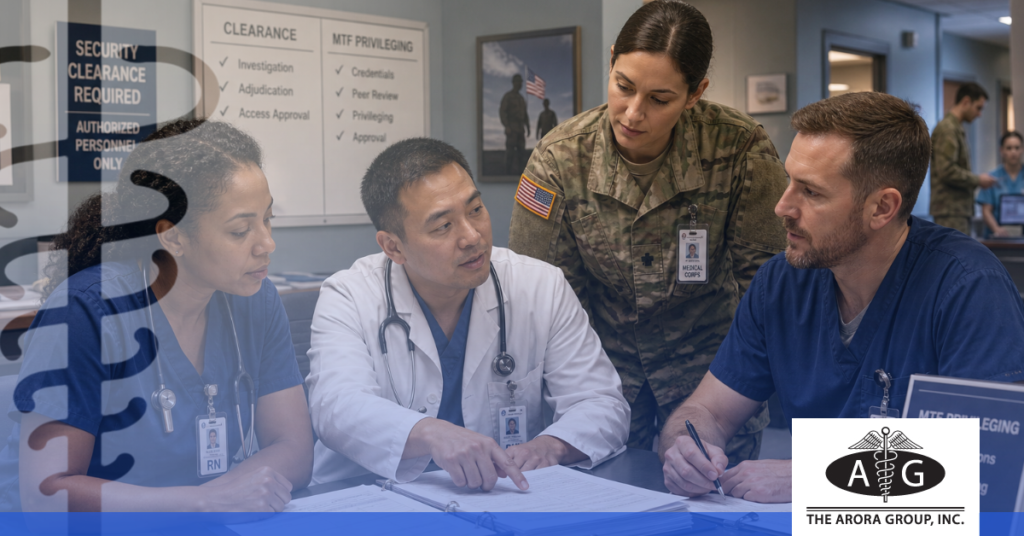
Clinicians applying to work in a military treatment facility, or MTF, may encounter several reviews that do not usually appear together in a private-sector hiring process. Professional credentials must be verified. Some practitioners need clinical privileges. The position may require a background investigation, fitness or suitability determination, facility-access credential, or—less commonly for routine clinical work—a formal national security clearance.
These processes protect different interests. Credentialing and privileging focus primarily on clinical qualifications, competence, scope, and patient safety. Personnel vetting and access reviews focus on whether an individual is eligible for the position, access, or classified information involved.
The terms are often used interchangeably, which creates unnecessary confusion. Understanding the differences can help clinicians submit accurate information, avoid preventable delays, and ask better questions before making career decisions.
The Arora Group recruits healthcare professionals for medical government contract jobs nationwide and helps candidates navigate interviewing, credential validation, screening, and onboarding requirements.
The Four Reviews Clinicians Should Distinguish
1. Healthcare Credentialing
Credentialing verifies that a clinician possesses the education, training, licensure, certification, experience, and professional history required for the role.
The process may include primary-source verification of:
- Professional licenses
- Education and postgraduate training
- Board certification or eligibility
- Work history
- Clinical references
- Specialty certifications
- Malpractice and claims history
- Adverse professional actions
- Other contract- or facility-specific qualifications
Credentialing confirms the evidence behind a clinician’s qualifications. It does not, by itself, authorize every clinical activity the clinician may be licensed to perform.
2. MTF Clinical Privileging
Privileging authorizes a qualified practitioner to provide defined clinical services at an MTF. The approved scope may depend on training, current competence, recent experience, facility capabilities, staffing needs, and the privileges requested.
Examples may include privileges to:
- Admit and manage patients
- Perform specific procedures
- Provide emergency or inpatient services
- Prescribe within an approved scope
- Interpret diagnostic studies
- Practice independently or under defined supervision
Not every healthcare worker requires clinical privileges. Requirements depend on profession, role, and facility policy. Nurses, technicians, and allied health professionals may undergo credential verification, competency validation, scope review, or other authorization processes without receiving privileges in the same way as an independently practicing physician or advanced practice clinician.
The Department of Defense uses the Centralized Credentials Quality Assurance System to support credentialing, privileging, risk management, and adverse-action functions across the Military Health System.
3. Suitability or Fitness Review and Facility Access
Many federal employees and contractors undergo a background investigation even when their position does not require access to classified information. The government may use the resulting information to make a suitability, fitness, credentialing, or access decision appropriate to the position.
A role may also require a facility-access credential, such as a Common Access Card or another identity credential, after applicable identity proofing and vetting requirements are satisfied.
The Defense Counterintelligence and Security Agency explains that the type and depth of investigation depend on the position and the potential effect of the individual’s duties. Review the official investigations and clearance process for a general overview.
4. National Security Clearance
A personnel security clearance is an eligibility determination related to access to classified national security information. It is not synonymous with every background check, suitability review, public-trust investigation, or facility-access process.
A candidate cannot independently obtain or activate a clearance simply to improve a résumé. The process begins when an authorized employer or government sponsor determines that the position requires access to classified information and initiates the appropriate steps. DCSA describes this sponsorship requirement in its guidance on processing clearance applicants.
Some government healthcare positions require a formal clearance. Many require other forms of vetting or access approval instead. Read the job posting and ask the recruiter which specific determination applies.
Why Credentialing and Clearance Are Not Interchangeable
A clinician can be fully licensed and clinically qualified but still be waiting for a required personnel-vetting or access determination. Conversely, an individual may satisfy a background or security requirement but lack the verified qualifications or approved privileges necessary to provide patient care.
The reviews also examine different evidence:
| Process | Primary purpose | Typical focus |
|---|---|---|
| Credentialing | Verify professional qualifications | Licensure, education, training, certification, work and professional history |
| Privileging | Authorize defined clinical services | Current competence, requested scope, facility capability, clinical need |
| Suitability/fitness/access | Determine eligibility for work or access | Position risk, identity, background, conduct, applicable federal standards |
| Security clearance | Determine eligibility for classified access | National security adjudication for a position requiring classified access |
One approval does not automatically replace another. Candidates should wait for confirmation that every required process is complete before assuming they are ready to practice.
Does Every VA or MTF Clinician Need a Security Clearance?
No. Requirements are position-specific.
A clinician working in a government facility may need credentialing, clinical privileges, a background investigation, occupational health clearance, identity credential, system access, or facility approval without needing access to classified information.
Do not assume that:
- Every VA clinician needs a DoD security clearance
- Every MTF position is classified
- A Common Access Card proves clearance eligibility
- A background check is the same as a clearance
- A prior clearance automatically satisfies a new position’s access requirements
Ask the recruiter or security contact to name the required process precisely. Useful questions include:
- Does this position require a national security clearance?
- If so, what level of eligibility is required?
- Does the role instead require suitability, fitness, public-trust, or facility-access review?
- Which organization sponsors and manages the process?
- Must all reviews be complete before the start date?
The Arora Group’s overview of security clearances in healthcare contracts provides additional candidate-focused context.
How Credentialing, Privileging, and Vetting Fit Together
There is no universal sequence for every government healthcare role. Steps may occur sequentially, in parallel, or in overlapping phases based on the contract and facility.
A typical workflow may include:
- Application and recruiter screening
- Conditional selection or offer, where applicable
- Credentialing packet submission and verification
- Background, fitness, suitability, or security forms initiated by an authorized sponsor
- Occupational health and position-specific screening
- MTF clinical review and privileging, when required
- Facility, identity, and system-access processing
- Orientation and local competency requirements
- Written confirmation of the approved start date and scope
This is only an illustration. Candidates should follow the instructions provided for the actual opening. The Arora Group explains its broader government healthcare hiring process from application through onboarding.
Documents and Information You May Need
Prepare an organized index of professional records, but do not place sensitive identity or background information into an unsecured personal “dossier.” Submit each item only when requested by an authorized party through the approved secure channel.
Professional Credentialing Records
- Current CV with complete month-and-year history
- Active professional licenses
- Board-certification or eligibility records
- Education and postgraduate training details
- Specialty and life-support certifications
- Continuing education records, if requested
- Clinical references
- Procedure or case logs, where applicable
- Prior privilege information
- Malpractice and claims history
- Professional disciplinary or adverse-action information
- Explanations for work, education, or training gaps when requested
Personnel-Vetting Information
An authorized questionnaire may request detailed personal history, such as residences, employment, education, travel, citizenship, contacts, legal matters, or financial information. The exact scope depends on the investigation and form.
Do not guess, conceal, or “clean up” information. DCSA advises applicants that withholding, misrepresenting, or falsifying requested information can affect position or access eligibility. If you are uncertain how to answer a question, use the official instructions or contact the authorized security representative.
Identity and Access Materials
Identity documents, fingerprints, photographs, or other proof may be required at defined stages. Never email a Social Security number, passport image, birth certificate, or completed security questionnaire unless the authorized instructions explicitly direct you to a secure method.
What Clinical Reviewers Evaluate for Privileging
Privileging authorities focus on whether the clinician is qualified and currently competent to perform the requested services safely in that facility.
Evidence may include:
- Education and specialty training
- Active, unrestricted licensure as required
- Board status
- Recent clinical experience
- Current competence
- Procedure volume or case mix
- Peer references
- Professional conduct history
- Quality and safety information
- Requested scope relative to facility resources
Use precise, verifiable evidence in application materials. For example, describe your role in a quality-improvement initiative, the method used, your individual contribution, and the documented result. Do not invent percentages, imply sole credit for a team outcome, or adapt a hypothetical metric as if it were your own.
DoD Instruction 6025.13 describes credentialing and privileging as components of the Military Health System’s clinical quality management framework. Clinicians and administrators can review the official DoD medical quality assurance and clinical quality management instruction for policy context.
What Personnel-Vetting Reviewers Evaluate
Personnel-vetting decisions are governed by the standards applicable to the position and determination. Clinical performance and a clean disciplinary record do not substitute for the information required in an official background or security process.
The most useful actions for an applicant are straightforward:
- Provide complete and accurate information
- Follow the official form instructions
- Meet deadlines
- Respond to requests for clarification
- Disclose requested matters honestly
- Keep contact information current
- Report changes when instructed
- Protect sensitive information throughout the process
Do not create a self-promotional “security narrative” unless the authorized process asks for an explanation. Official reviewers need accurate responses to specific questions, not a marketing document about trustworthiness.
Common Causes of Delay
Timelines vary widely and should not be promised. Credentialing, privileging, and personnel vetting can each depend on different organizations and external responses.
Common delays include:
- Incomplete forms
- Inconsistent employment or education dates
- Unexplained history gaps
- Expired licenses or certifications
- Slow primary-source verification
- Delayed references
- Missing claims or disciplinary documentation
- Changes to requested privileges
- Fingerprint or identity-processing issues
- Failure to respond to an authorized request
- Facility workload or approval schedules
- Incorrect assumptions about reciprocity or prior approvals
Candidates can control accuracy, organization, responsiveness, and transparency. They cannot control every government or facility processing time.
For realistic preparation guidance, see Understanding the Hiring Timeline for Government Healthcare Roles.
A Practical Pre-Application Checklist
Review the Job Posting
- Identify the exact employer and worksite.
- Confirm whether privileges are required.
- Note every license, certification, and experience requirement.
- Determine whether the posting names a clearance, suitability, fitness, or access requirement.
- Record the stated employment classification and schedule.
Organize Professional Credentials
- Update the CV with complete dates.
- Verify license and certification status.
- Gather official contact information for schools, training programs, employers, and references.
- Review prior privilege records and professional disclosures for accuracy.
- Prepare role-relevant case or procedure information only if requested.
Prepare for Vetting
- Wait for sponsorship and official instructions.
- Begin reconstructing accurate residence, education, and employment history if the authorized form requires it.
- Use the designated secure portal.
- Keep copies only as permitted and protect them appropriately.
- Ask the assigned security contact—not an informal online source—about form-specific questions.
Plan Conservatively
- Do not resign based only on an interview or verbal estimate.
- Do not relocate before the start date is confirmed in writing.
- Keep expiring credentials current during the review.
- Inform the recruiter promptly of material changes.
Questions to Ask the Recruiter or Credentialing Team
- Which credentialing and privileging standards apply to this role?
- What exact privileges will be requested?
- Which documents should I submit now?
- Which secure system should I use?
- Does the role require classified access, or a different type of background or access determination?
- Who is the authorized security contact?
- Which steps can run in parallel?
- What must be complete before a start date can be issued?
- How often will I receive a status update?
- Will previous credentials, privileges, or investigations be reviewed for reciprocity?
- What orientation, EHR, and local competency training follows approval?
Illustrative Scenario: Preparing Without Overclaiming
Consider a hypothetical trauma physician applying for an MTF contract role. The position requires credential verification, defined emergency medicine privileges, occupational health clearance, facility access, and a position-specific background review.
The clinician updates a CV with complete dates, verifies all licenses and certifications, and supplies references through the approved credentialing channel. When the authorized security representative initiates the background process, the clinician follows the official instructions and provides accurate explanations for requested history.
The credentialing and vetting activities overlap, but the MTF does not permit independent practice until the required clinical privileges and access approvals are confirmed. The clinician waits for a written start date before relocating.
This scenario is illustrative. It does not represent an actual candidate, promise a processing time, or imply that every MTF role uses the same sequence.
Move Forward With Accurate Expectations
Security clearance and MTF privileging are not a single approval. They are distinct processes designed for different purposes. A clinician may need credentialing and privileges to provide care, a background or fitness review to work in the position, and an access credential to enter systems or facilities. A formal security clearance applies only when the position requires classified access.
Start with three steps:
- Review the posting and ask which exact approvals apply.
- Organize professional credentials without placing sensitive personal data in an unsecured file.
- Follow only authorized instructions for background, access, and security submissions.
Ready to explore government healthcare opportunities? Search current jobs with The Arora Group or contact a healthcare recruiter for position-specific information.